



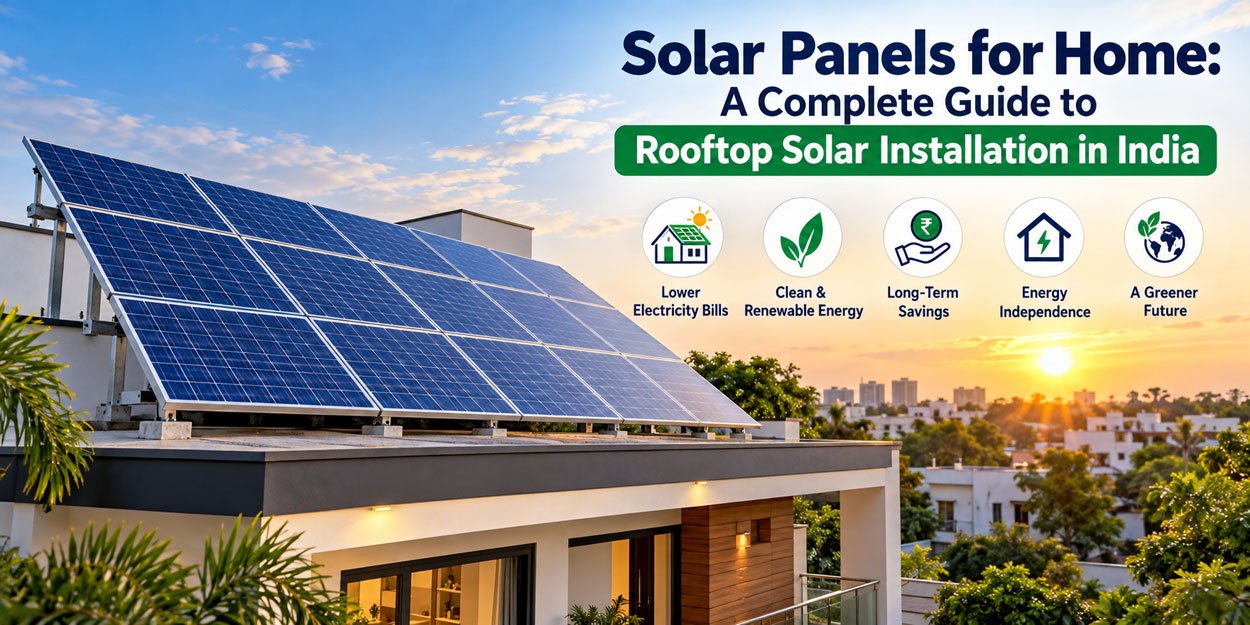
Solar Panels for Home: A Complete Guide to Rooftop Solar Installation in India
Electricity costs are an important consideration for many Indian households. As energy consumption increases through air conditioners, refrigerators, water pumps, computers and other appliances, homeowners are exploring cleaner and more predictable ways to generate power.
Installing solar panels for home use can help households produce electricity from sunlight and reduce dependence on conventional grid power. A properly designed rooftop solar system can support everyday household consumption while making better use of available roof space.
However, choosing solar panels is not simply a matter of buying modules and placing them on a roof. The right solution depends on electricity consumption, roof area, shading, system type, local approvals, budget, backup requirements and long-term maintenance.
This guide explains how solar systems work, how to select the right option for your home, what affects solar panels for home cost and what to expect during solar panel installation.
What are solar panels?
Solar panels contain photovoltaic cells that convert sunlight into direct-current electricity. An inverter then converts this electricity into alternating current, which can be used by household appliances.
A complete home solar system may include:
- Solar panels.
- Solar inverter.
- Mounting structure.
- DC and AC cables.
- Protection devices.
- Earthing and lightning protection.
- Monitoring equipment.
- Battery storage, where required.
- Bi-directional or net meter for eligible grid-connected systems.
The panels are only one part of the complete system. Design, electrical integration, safety and installation quality also affect system performance.
How do rooftop solar systems work?
A typical rooftop solar system works in the following sequence:
Solar panels capture sunlight and generate DC electricity.
The inverter converts DC electricity into AC electricity.
The home uses the generated solar power for appliances and other loads.
Surplus electricity may be exported to the grid in an eligible on-grid system.
When solar generation is insufficient, the home draws electricity from the grid.
A monitoring system can help track generation and performance.
During the day, solar power is generally used as it is generated. At night, a grid-connected home usually relies on the electricity grid unless it has suitable battery storage.
Types of solar systems for homes
On-grid solar system
An on-grid system is connected to the electricity grid. It usually does not include batteries and is often selected by homeowners who have reasonably reliable grid supply.
When the system generates more electricity than the home is using, surplus power may be exported to the grid, subject to applicable regulations and the local electricity provider's process.
An on-grid system can be suitable for homeowners who:
- Want to reduce grid electricity consumption.
- Have a suitable rooftop.
- Do not need backup power for every outage.
- Prefer a system with fewer components than a battery-based setup.
Off-grid solar system
An off-grid system operates independently of the electricity grid and normally requires batteries. It may be considered for remote locations or sites where grid availability is limited.
The system must be designed carefully around:
- Daily energy consumption.
- Peak loads.
- Battery capacity.
- Backup duration.
- Seasonal solar generation.
- Appliance starting currents.
Hybrid solar system
A hybrid system combines solar generation, grid connection and battery storage. It can provide greater flexibility where the homeowner wants to reduce grid usage and maintain backup power for selected loads.
A hybrid solar inverter manages energy flows between the solar panels, household loads, grid and battery. The right configuration depends on the loads that need backup, expected outage duration and the customer's budget.
A hybrid system may be useful for homes with:
- Frequent power interruptions.
- Essential loads such as lights, fans, routers or refrigerators.
- A need for backup during evening hours.
- An interest in combining solar generation with battery storage.
How to check if your home is suitable
Before requesting a quotation for solar panels for your house, assess the following factors.
1. Electricity consumption
Review at least several months of electricity bills where possible. Note:
- Monthly units consumed.
- Seasonal variation.
- Tariff category.
- Fixed charges.
- Major daytime and nighttime loads.
- Use of air conditioners, pumps and electric vehicles.
A system should be sized around realistic consumption and site conditions, not only around the maximum roof area available.
2. Available roof area
The roof should have enough usable space for the required number of panels, mounting structures and safe maintenance access. Water tanks, staircases, parapet walls, ventilation equipment and other obstructions can reduce the usable area.
3. Shading
Shadows from trees, nearby buildings, tanks and overhead structures can reduce output. Shading should be evaluated during different times of the day and across seasons.
4. Roof condition
The roof should be structurally suitable and accessible for installation and future maintenance. If waterproofing or major repair work is pending, it may be better to complete that work before installing the mounting structure.
5. Electrical infrastructure
The installer should review the home's distribution board, cable routing, earthing, protection devices and connection requirements.
6. Local approvals
Grid connection, net metering, documentation and subsidy processes can depend on the relevant electricity distribution company and current government guidelines.
Solar panel installation process
A professional solar panel installation generally includes the following steps.
Initial consultation
The installer discusses electricity consumption, roof type, customer goals, backup requirements and budget.
Site survey
The site team checks roof area, orientation, shading, structural conditions, electrical infrastructure, cable routes and access.
System design
The design should specify the approximate system capacity, panel layout, inverter, mounting structure, protection equipment and expected operating configuration.
Commercial proposal
The quotation should clearly state what is included and excluded, including equipment, installation, approvals, testing, commissioning, monitoring, warranties and post-installation support.
Approvals and documentation
For grid-connected systems, the required applications and documents should be prepared according to the applicable local process.
Mounting structure installation
The structure is installed and aligned to support the panels safely. Roof penetrations, sealing and drainage should be handled carefully.
Panel and inverter installation
The panels are secured to the structure. The inverter, protection devices and cables are installed according to the system design and relevant safety requirements.
Testing and commissioning
The installer checks electrical connections, protection systems, generation, monitoring and grid integration before handing over the system.
What affects solar panels for home cost?
Solar panels for home cost varies from one project to another. A reliable estimate should be based on a site assessment rather than a generic advertised price.
Major cost factors include:
- Required system capacity.
- Panel technology and specifications.
- Inverter type and capacity.
- Battery storage, if applicable.
- Mounting structure.
- Roof height and accessibility.
- Electrical upgrades.
- Cable length and routing.
- Approvals and metering requirements.
- Monitoring and protection systems.
- Installation complexity.
- O&M and warranty terms.
An on-grid system may have a different cost structure from a hybrid system because a hybrid system generally includes batteries and a compatible hybrid solar inverter.
When comparing quotations
Homeowners should check whether the price includes:
- Equipment specifications.
- Installation and commissioning.
- Approvals support.
- GST and other charges.
- Warranty details.
- Monitoring.
- Maintenance.
- Transportation.
- Any civil or electrical work.
How much can a home save?
Savings depend on:
- System capacity.
- Solar radiation at the location.
- Roof orientation and shading.
- Household consumption.
- Electricity tariff.
- Daytime usage.
- System availability.
- Local net-metering or billing rules.
- Cleaning and maintenance.
Any estimate should clearly identify its assumptions. A professional feasibility assessment is more useful than a generic savings promise because every home has different electricity use and roof conditions.
Solar panels for your home: Checklist before buying
Before selecting solar panels for your home, ask:
Frequently asked questions
Are solar panels suitable for every house?
Not necessarily. Suitability depends on roof area, sunlight, shading, structural condition, electrical infrastructure and local requirements. A site survey should be completed before finalizing the system.
Do solar panels work during cloudy weather?
Solar systems can generate electricity in cloudy conditions, but output may be lower than during strong sunlight. Generation varies according to weather, shading, panel orientation, system design and local conditions.
Is a battery required for rooftop solar?
A battery is not always required. Many homes use on-grid systems without batteries. Battery storage may be considered where backup power is important or where a hybrid system is preferred.
Can a hybrid solar inverter run the entire house during a power cut?
That depends on inverter capacity, battery capacity, load size and the system's backup design. Essential loads may be backed up, while high-power appliances may require a larger configuration.
Can homeowners install solar panels themselves?
Rooftop and grid-connected solar power installation involves structural, electrical and safety considerations. Professional installation is recommended to reduce risks and support proper testing, approvals and warranty compliance.
Conclusion
Solar panels for house use can be a practical way to generate cleaner electricity and manage long-term energy costs. The best solar systems are not chosen only by panel count or price; they are designed around the home's consumption, roof, electrical infrastructure, backup needs and local requirements.
Planning solar panels for your home?
Contact Conservit for an initial site assessment and understand the suitable rooftop solar options for your home.