


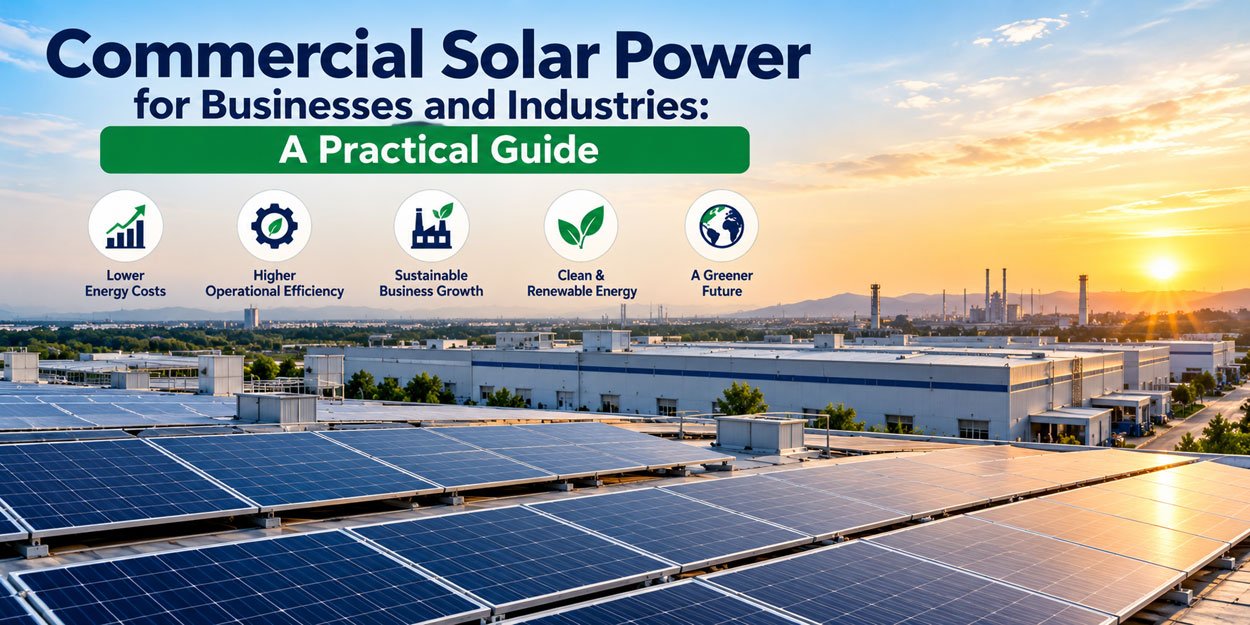
Commercial Solar Power for Businesses and Industries: A Practical Guide
Electricity is a significant operating cost for many businesses. Manufacturing plants, warehouses, offices, hospitals, schools, hotels and commercial buildings often consume substantial amounts of power during the day—the same period when rooftop solar can generate electricity.
This has increased interest in commercial solar power as a way to generate on-site energy and improve long-term energy planning.
For businesses, solar is not only an environmental initiative. It can also be evaluated as an infrastructure investment connected to operating costs, energy resilience and sustainability goals.
However, a commercial solar project must be assessed more carefully than a basic residential installation. System size, tariff structure, demand charges, roof condition, electrical infrastructure, operating hours, financing, approvals, safety and maintenance all influence the outcome.
This guide explains how businesses can evaluate commercial solar, what to look for in a commercial solar system and how industrial solar can be planned for factories and large facilities.
What is commercial solar power?
Commercial solar power refers to solar electricity systems designed for businesses, institutions and commercial facilities.
These systems may be installed on:
- Office buildings.
- Factories.
- Warehouses.
- Retail buildings.
- Schools and colleges.
- Hospitals.
- Hotels.
- Housing societies.
- Agricultural and industrial facilities.
- Large institutional campuses.
Commercial systems are generally designed using the customer's electricity profile, available roof or land area, tariff structure, operating schedule and project goals.
A commercial solar system may be connected to the grid, integrated with battery storage or designed as part of a broader energy-management solution.
Why businesses are considering commercial solar
Reduce dependence on grid electricity
A suitable solar system can generate electricity on-site during daylight hours. This can reduce the amount of power a business needs to purchase from the grid, subject to system design and applicable regulations.
Improve energy-cost visibility
Electricity costs can change because of tariffs, demand charges, operating schedules and other billing components. Generating part of the required energy on-site can support more predictable energy planning.
Use available roof space
Warehouses, factories and commercial buildings often have large rooftops that remain unused. These spaces may be evaluated for solar, provided they are structurally suitable and free from excessive shading.
Support sustainability goals
Businesses increasingly track emissions, renewable-energy use and environmental performance. Commercial solar can form part of a broader sustainability programme.
Reduce exposure to daytime energy costs
Facilities that operate heavily during daylight hours may be able to consume a significant portion of solar generation directly. The value depends on the customer's load profile and tariff structure.
Solar power for industries: key applications
Solar power for industries can be designed for different sectors and load profiles.
Manufacturing facilities
Factories may have large daytime loads from machinery, compressors, pumps, HVAC systems and process equipment. Solar planning must account for production schedules, power quality, electrical integration and available roof area.
Warehouses and logistics facilities
Warehouses often have expansive roofs and predictable daytime operations. The design should consider roof loading, fire safety, access paths, drainage, ventilation and future maintenance.
Commercial offices
Office buildings may use power for lighting, cooling, elevators, IT systems and common areas. Load analysis should identify how much electricity is consumed during solar-generation hours.
Hotels and hospitals
These facilities may have long operating hours and critical loads. A grid-connected system may reduce daytime consumption, while backup requirements need a separate technical evaluation.
Schools and institutions
Schools, colleges and campuses can use solar to reduce common-area electricity costs and support sustainability education. The system may also become a visible demonstration of renewable energy.
What is an industrial solar system?
An industrial solar project is usually designed for a large or energy-intensive facility. It may involve a higher system capacity, complex electrical integration, multiple rooftops, large cable routes, transformers, protection equipment, monitoring systems and more detailed safety planning.
Industrial solar projects often require attention to:
- Plant operating schedules.
- Connected load and maximum demand.
- Transformer capacity.
- Power-quality requirements.
- Roof loading and structural design.
- Process interruptions.
- Fire and electrical safety.
- Equipment access.
- Shutdown planning.
- Monitoring and O&M.
- Future plant expansion.
Components of a commercial solar system
A typical commercial solar system may include:
- Commercial-grade solar modules.
- String or central inverters.
- Mounting structures.
- DC and AC cables.
- Combiner boxes and protection equipment.
- Earthing and lightning protection.
- Transformers or electrical integration equipment.
- Monitoring and data-logging systems.
- Net meter or other metering infrastructure, where applicable.
- Safety signage and access provisions.
- Optional battery storage.
- O&M and performance-support services.
The selected equipment should match the site, capacity, environmental conditions, electrical design and required service support.
Choosing solar panels for commercial buildings
When evaluating solar panels for commercial buildings, businesses should consider more than rated capacity.
1. Available area
The design should consider usable roof area after accounting for walkways, equipment, setbacks, drainage and safety access.
2. Structural suitability
The roof must be able to support the proposed mounting arrangement and withstand local environmental conditions. Existing roofs may require a structural assessment.
3. Shading and orientation
Shadows from parapets, nearby buildings, tanks, HVAC equipment and trees can affect generation. The layout should reduce avoidable shading and provide safe maintenance access.
4. Module technology
Module type, efficiency, temperature characteristics, warranty terms, dimensions and availability should be evaluated against the site's requirements.
5. Inverter configuration
The inverter design affects monitoring, maintenance, system segmentation and response to different rooftop conditions. Large or complex sites may require multiple inverter units.
6. Environmental conditions
Dust, humidity, heat, salt exposure and industrial pollutants can influence cleaning, equipment selection and maintenance requirements.
7. Future expansion
If the facility may expand its electrical load or roof usage, the initial design should consider future constraints where practical.
Commercial solar project assessment
A proper feasibility study should examine the following.
Electricity consumption
Review at least 12 months of electricity bills where possible. Analyze:
- Monthly energy consumption.
- Tariff category.
- Energy charges.
- Demand charges.
- Time-of-use tariffs.
- Seasonal production changes.
- Power-factor penalties.
- Daytime versus nighttime load.
- Shutdown periods.
Site and roof conditions
The site assessment should review:
- Roof dimensions.
- Structural condition.
- Roof material.
- Shading.
- Orientation.
- Access.
- Drainage.
- Existing equipment.
- Cable paths.
- Fire and safety requirements.
Electrical infrastructure
The engineering team may need to inspect:
- Main distribution boards.
- Transformers.
- Protection systems.
- Cable routes.
- Earthing.
- Available connection capacity.
- Metering configuration.
- Power-quality conditions.
Commercial structure
The customer should understand whether the project is being considered through:
- Direct purchase or CAPEX.
- Third-party investment or OPEX.
- Lease or energy-service arrangement.
- Financing.
- A combination of models.
Each structure has different ownership, payment, maintenance, risk and contract implications.
CAPEX and OPEX models
CAPEX model
Under a CAPEX model, the business funds the project and generally owns the system. The business may receive the long-term value of the generated electricity, while also taking responsibility for the investment and asset management.
Important questions include:
- What is the total project cost?
- What is the expected generation?
- Who manages O&M?
- What are the warranty terms?
- What approvals and taxes are included?
- How is the asset treated in the company's accounts?
- What happens if the facility moves or changes ownership?
OPEX model
Under an OPEX or third-party model, another party may finance, own or operate the system under a long-term agreement. The business typically pays for the electricity or service according to agreed terms.
Important questions include:
- How is the tariff calculated?
- Is there an escalation clause?
- Who owns the equipment?
- Who handles maintenance and repairs?
- What is the contract duration?
- What happens if energy consumption changes?
- What are the exit and transfer conditions?
How to evaluate commercial solar ROI
A commercial solar estimate should show its assumptions clearly. At a minimum, review:
- System capacity.
- Expected annual generation.
- Self-consumption percentage.
- Export assumptions.
- Electricity tariff.
- Demand-charge treatment.
- System cost.
- Financing cost.
- O&M expenses.
- Equipment degradation.
- Downtime assumptions.
- Contract duration.
- Expected project life.
This is only an initial indicator. A more complete analysis may include financing cost, tax treatment, escalation, degradation, maintenance and discounted cash flow.
Businesses should ask vendors to provide the assumptions behind every savings or payback figure. A commercial solar panel quotation with an attractive headline number is not necessarily the best proposal if the underlying assumptions are unrealistic.
Commercial solar installation process
A typical project may include:
Initial business and energy assessment
Collection of electricity bills and site information
Technical site survey
Structural and electrical evaluation
Solar resource and shading assessment
System design and generation modelling
Commercial and financial proposal
Approvals and documentation
Procurement and logistics planning
Mounting structure installation
Panel, inverter and electrical installation
Testing and commissioning
Grid synchronization or metering process, where applicable
Handover and documentation
O&M and performance monitoring
Industrial solar panels and maintenance
The performance of industrial solar panels depends not only on the panel specification but also on the condition of the complete system.
A commercial or industrial O&M programme may include:
- Module cleaning.
- Visual inspection.
- Inverter inspection.
- Cable and connector checks.
- Mounting-structure inspection.
- Earthing and lightning-protection checks.
- Monitoring review.
- Thermographic inspection, where appropriate.
- Vegetation or obstruction control.
- Fault response.
- Generation and performance reporting.
- Preventive maintenance scheduling.
Common mistakes in commercial solar projects
Businesses should avoid:
- Sizing the system only from roof area.
- Ignoring demand charges.
- Using one electricity bill for a large investment decision.
- Assuming all generated energy will be self-consumed.
- Selecting equipment only by lowest price.
- Ignoring roof repairs or replacement plans.
- Underestimating cable and electrical-integration requirements.
- Failing to plan maintenance access.
- Accepting savings claims without assumptions.
- Not checking warranty and service terms.
- Treating commercial solar as a one-time installation instead of a long-term asset.
Frequently asked questions
What is the difference between commercial and industrial solar?
Commercial solar generally refers to systems for offices, shops, schools, hospitals, warehouses and other business facilities. Industrial solar usually serves larger or more energy-intensive facilities such as factories and manufacturing plants. The distinction depends on the project's size, load, electrical complexity and application.
Are solar panels for commercial buildings suitable for every roof?
No. The roof must be evaluated for structural condition, usable area, shading, access, drainage, safety and electrical integration.
How many solar panels does a business need?
The number depends on the target system capacity, module wattage, available roof area, electricity consumption, design configuration and generation expectations.
Is commercial solar always connected to the grid?
No. Commercial systems may be on-grid, hybrid or off-grid, depending on the facility's electricity supply, backup requirements and project objective. On-grid systems are common, but the appropriate configuration requires a project-specific evaluation.
What is the life of a commercial solar system?
The operating life depends on the quality of the equipment, installation, environmental conditions, monitoring and maintenance. Individual components may have different warranty and replacement periods.
Does industrial solar require regular maintenance?
Yes. Preventive maintenance helps identify issues with panels, inverters, wiring, structures, protection systems and monitoring before they cause extended downtime or reduced generation.
Conclusion
Commercial solar power can help businesses evaluate electricity generation as part of a broader energy and cost-management strategy.
For factories and large facilities, industrial solar requires careful analysis of consumption, roof structure, electrical infrastructure, safety, financing, expected generation and long-term O&M.
The right commercial solar panel solution is not necessarily the largest or least expensive system. It is the system that is technically suitable, financially transparent, safely executed and supported throughout its operating life.
Planning Solar Power for Your Business?
Conservit Power Solutions can help businesses assess their site and understand suitable commercial and industrial solar options.